
Post-Treatment Moisturizer: The 6 Ingredients Inside GloLuxe
Peptides, vitamin C, hyaluronic acid, niacinamide, vitamin E, and ceramides. Here’s what each ingredient in GloLuxe does, and why they belong together in a post-treatment moisturizer.
- The Part of Your Results That Happens at Home
- What’s Inside GloLuxe: 6 Ingredients, One Job
- Why I Formulated GloLuxe This Way
- Where GloLuxe Fits in Your Routine
- The Skin-First Philosophy Behind It
I spend my days placing filler with millimeter precision, mapping laser passes, and planning treatment sequences months in advance. Then my patients go home, and their skin spends the next four weeks without me.
That gap is where results are kept or lost. It’s why I created GloLuxe, and why I chose every ingredient in it on purpose: peptides, vitamin C, hyaluronic acid, niacinamide (vitamin B3), vitamin E, and ceramides. Here’s what each one does, and why they belong together in a post-treatment moisturizer.
1. The Part of Your Results That Happens at Home
Every treatment we perform asks something of your skin. Microneedling, lasers, peels, and even a well-planned injectable appointment leave skin wanting extra comfort and hydration while it settles. Add Gulf Coast sun, salt air, and air conditioning running most of the year, and dehydrated skin becomes the default.
The outermost layer of your skin, the barrier, keeps water in and irritants out. When it’s well supported, skin looks smoother, feels comfortable, and reflects light the way healthy skin should. Research has long described moisturizers as a cornerstone of daily skin care, particularly when the barrier is compromised and skin is dry.[1]
2. What’s Inside GloLuxe: 6 Ingredients, One Job
Good moisturizers balance humectants that draw water in, emollients that soften, and barrier lipids that help hold moisture where it belongs. Published reviews show formulations differ widely, and some support barrier function noticeably better than others.[2] I built GloLuxe so each ingredient covers a different part of that job.
- Hyaluronic Acid (HA): draws in and holds hydration
- Ceramides: support the skin barrier and help lock moisture in
- Niacinamide (Vitamin B3): smoother-looking texture and more even-looking tone
- Peptides: support firmer, smoother-looking skin
- Vitamin C: antioxidant support and a brighter-looking complexion
- Vitamin E: antioxidant support and a soft, conditioned feel
Hyaluronic Acid (HA): Hydration First
Hyaluronic acid is one of the skin’s own moisture-binding molecules, known for holding a remarkable amount of water. Natural levels decline as skin ages, which is part of why skin can look less plump over time.[3] In GloLuxe, HA delivers the immediate hit of hydration that tight, post-treatment skin is asking for.
Ceramides: Barrier Support
Ceramides are lipids that make up a large part of the skin’s outer barrier, the “mortar” between skin cells that keeps water from escaping.[4] After a treatment, that barrier is working overtime. Ceramides help GloLuxe keep the hydration HA brings in from evaporating right back out.
Niacinamide (Vitamin B3): Smoother, More Even-Looking Skin
Niacinamide is one of the most studied ingredients in skincare. In a clinical study, topical niacinamide improved the appearance of fine lines, blotchiness, and uneven tone in aging facial skin.[5] It’s also well tolerated, which is why it earns a place in a moisturizer meant for sensitive, recovering skin.
Peptides: Support for Firmer-Looking Skin
Peptides are short chains of amino acids, the building blocks of proteins like collagen. Cosmetic peptides are used to support the look of firmer, smoother skin.[6] They pair naturally with the collagen-focused work we do in-office, from a microneedling treatment series to biostimulators.
Vitamin C: Antioxidant Brightness
Healthy skin naturally contains high levels of vitamin C, which acts as an antioxidant and plays a role in collagen production.[7] Sun exposure depletes it. In GloLuxe, vitamin C adds antioxidant support for skin that sees a lot of Florida sun, and helps the complexion look brighter.
Vitamin E: Antioxidant Partner
Vitamin E is the skin’s main fat-soluble antioxidant and a long-trusted conditioning ingredient.[8] It works well alongside vitamin C, and it gives GloLuxe its soft, comfortable finish.
“The best injectables are undetectable, and the best skin looks cared for, not covered up.”
— Ashley McShurley, ACNP-BC
3. Why I Formulated GloLuxe This Way
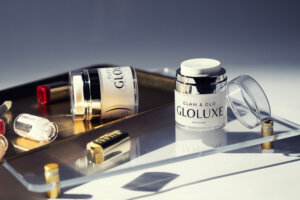
GloLuxe: Six Ingredients, One Step
I didn’t set out to make a product. I set out to solve a problem I saw every week: patients with beautiful in-office results and a nightstand full of moisturizers that weren’t keeping up. Most covered one or two of these jobs. Very few covered hydration, barrier support, and antioxidant protection in one step.
GloLuxe is my answer. Together, these six ingredients are designed to:
- Hydrate skin that feels tight or dry after treatment (HA, ceramides)
- Support the barrier so moisture stays put (ceramides, niacinamide)
- Defend against everyday environmental stress (vitamins C and E)
- Keep skin looking smooth and firm between appointments (peptides, niacinamide)
- Layer cleanly alongside retinoids, acids, and medical-grade serums
It’s a Glam + Glo original. You won’t find it anywhere else.
4. Where GloLuxe Fits in Your Routine
After treatment. Once your provider clears you to resume skincare, GloLuxe becomes your daily step for keeping skin hydrated and comfortable. Every treatment has its own aftercare window, so always follow the specific instructions you leave with.
With actives. Retinoids and exfoliating acids are some of the most effective tools for photoaged skin, but dryness and irritation are why many people abandon them.[9] A ceramide- and HA-rich moisturizer is one of the simplest ways to stay consistent.
Every day. Apply to clean skin morning and evening, then follow with broad-spectrum SPF each morning. Vitamins C and E support your sunscreen; they don’t replace it.
As with any new product, patch test first if your skin is reactive.
5. The Skin-First Philosophy Behind It
GloLuxe follows the same belief behind everything we do, outlined in our guide Skin Health Before Injectables: healthy skin makes every treatment look better. The best injectables are undetectable, and the best skin looks cared for, not covered up.
Olivia Hightower, our Licensed Esthetician, can show you how to build GloLuxe into your routine alongside the medical-grade lines we carry, including Obagi, Neocutis, and Skinbetter Science. Whether you’re between Luxury Lift appointments, recovering from microneedling, or simply want a better daily moisturizer, there’s a place for it.
Ready to give your skin what it’s been missing? Ask for GloLuxe in our Panama City lounge, shop GloLuxe online, or book a consult with Olivia to build it into your routine.
Individual results may vary. GloLuxe is a cosmetic product intended to hydrate and support the appearance of the skin; it is not intended to diagnose, treat, cure, or prevent any medical condition. Always follow your provider’s aftercare instructions following an in-office treatment.
Hydrate, support, defend. Six ingredients chosen on purpose, in one post-treatment moisturizer from Glam + Glo.
Clinical References
- Purnamawati S, Indrastuti N, Danarti R, Saefudin T. The role of moisturizers in addressing various kinds of dermatitis: a review. Clin Med Res. 2017;15(3-4):75–87. doi:10.3121/cmr.2017.1363. PubMed: 29229630
- Lodén M. Role of topical emollients and moisturizers in the treatment of dry skin barrier disorders. Am J Clin Dermatol. 2003;4(11):771–788. doi:10.2165/00128071-200304110-00005. PubMed: 14572299
- Papakonstantinou E, Roth M, Karakiulakis G. Hyaluronic acid: a key molecule in skin aging. Dermatoendocrinol. 2012;4(3):253–258. PubMed: 23467280
- Coderch L, López O, de la Maza A, Parra JL. Ceramides and skin function. Am J Clin Dermatol. 2003;4(2):107–129. PubMed: 12553851
- Bissett DL, Oblong JE, Berge CA. Niacinamide: a B vitamin that improves aging facial skin appearance. Dermatol Surg. 2005;31(7 Pt 2):860–865. PubMed: 16029679
- Lupo MP, Cole AL. Cosmeceutical peptides. Dermatol Ther. 2007;20(5):343–349. PubMed: 18045359
- Pullar JM, Carr AC, Vissers MCM. The roles of vitamin C in skin health. Nutrients. 2017;9(8):866. PubMed: 28805671
- Thiele JJ, Hsieh SN, Ekanayake-Mudiyanselage S. Vitamin E: critical review of its current use in cosmetic and clinical dermatology. Dermatol Surg. 2005;31(7 Pt 2):805–813. PubMed: 16029671
- Mukherjee S, Date A, Patravale V, Korting HC, Roeder A, Weindl G. Retinoids in the treatment of skin aging: an overview of clinical efficacy and safety. Clin Interv Aging. 2006;1(4):327–348. doi:10.2147/ciia.2006.1.4.327. PubMed: 18046911